Platform
Data Classification
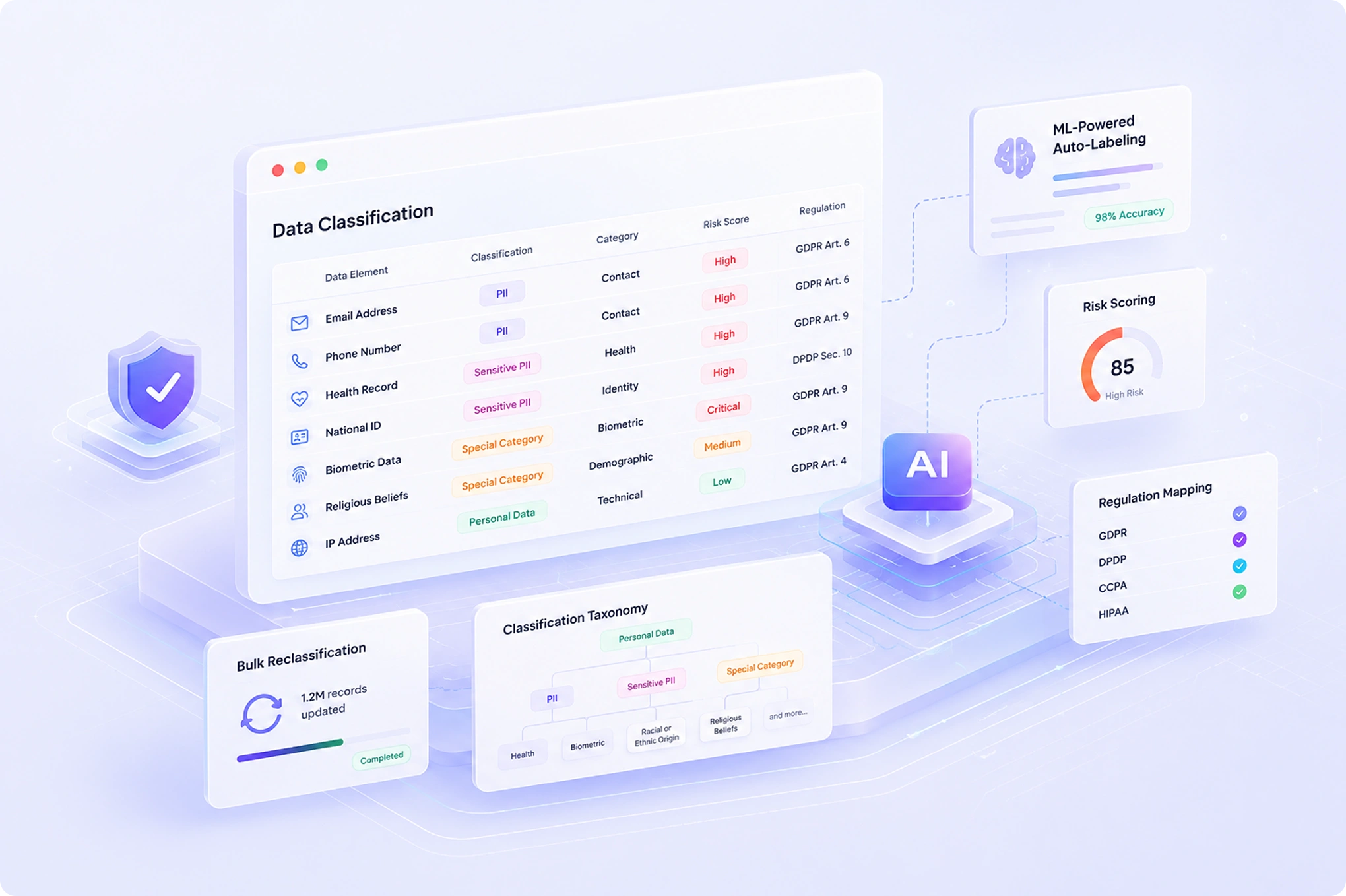
Apply intelligent classification labels to all personal data your organization holds — from basic contact info to special category data like health records and financial details.
Benefits
Why teams choose Data Classification
Automated Labeling
ML models classify data at ingestion with high accuracy, reducing manual effort by 90%.
Custom Taxonomies
Define your own classification categories that match your industry and internal policies.
Regulation Mapping
Automatically map data classes to relevant regulatory requirements (GDPR Art. 9, DPDP, etc.).
Risk Scoring
Every piece of data gets a risk score so you can prioritize what to protect first.
Capabilities
What Data Classification does
ML-Powered Auto-Labeling
Machine learning models classify discovered data at ingestion time. The models are trained on regulatory definitions across GDPR, DPDP, CCPA, HIPAA, and more, so labels align with your actual compliance obligations.
Custom Classification Taxonomies
Define your own classification categories to reflect your industry vertical or internal data governance policy. Custom categories sit alongside built-in ones and apply the same automated detection logic.
Special Category Detection
Automatically flag GDPR Article 9 special category data — health, biometric, racial/ethnic origin, religious beliefs, and more — and DPDP sensitive personal data, triggering elevated protection workflows.
Risk Scoring per Data Element
Every classified data element receives a risk score based on sensitivity category, volume, geographic spread, and access controls. Risk scores roll up to data store and system level for prioritization.
Bulk Reclassification
Apply updated classification rules retroactively across your entire inventory with a single operation. Useful when regulations change or your internal taxonomy evolves.
Regulation Mapping
Each classification label is mapped to the relevant regulatory articles it implicates — GDPR Art. 9, DPDP Schedule, CCPA sensitive categories — so your legal team sees direct compliance linkages.
How It Works
From setup to compliance
A few straightforward steps — no consultants required.
Ingest Discovered Data
Classification runs automatically on data found during the discovery scan. Every field, table, and file type is evaluated without manual input from your team.
Apply ML Labels
Models evaluate field names, sample values, and surrounding context to assign the most accurate classification label with a confidence score.
Review & Refine
Your team reviews classifications in the data inventory. Corrections and confirmations feed back into the model, continuously improving accuracy for your specific data environment.
Propagate to Compliance Tools
Classification labels flow automatically into your RoPA, DPIA workflows, and DSR automation so all downstream tools work from the same authoritative classification layer.
Included
Everything in the box
- 100+ built-in data categories
- Custom classification rules
- GDPR special category detection
- DPDP sensitive personal data tagging
- Bulk reclassification tools
- Audit trail for all classification changes
FAQ
Frequently asked questions
When a field name alone is ambiguous (e.g., 'ref_code'), the model samples the actual values in that field and uses contextual signals from surrounding fields to make a determination. Low-confidence classifications are flagged for human review rather than applied automatically.
Yes. The custom taxonomy builder lets you define any label with a name, description, and example values. You can also write custom detection rules using regex or keyword matching to complement ML detection.
The built-in taxonomy covers GDPR (including special categories), India DPDP Act, CCPA/CPRA, HIPAA, PCI-DSS, and several other national privacy laws. New regulations are added as they come into force, and your classifications are automatically re-evaluated against them.
Reclassification updates your live data inventory going forward. The audit trail preserves a complete history of previous classifications with timestamps, so you can demonstrate to regulators exactly what classification applied at any point in time.
Risk scores combine the inherent sensitivity of the data category (special category data scores highest), volume of records, geographic exposure, breadth of access (number of systems and users that can read the data), and the presence or absence of encryption and access controls. Scores are updated automatically as these factors change.
Ready to automate Data Classification?
Join hundreds of teams using TruePrivacy to manage privacy operations at scale.
Free 14-day trial · No credit card required · Setup in minutes