Solutions
TruePrivacy for
Telecom
Subscriber data governance at national scale
Telecom operators process identity, location, and usage data for hundreds of millions of subscribers under GDPR, DPDP, and licence-condition retention mandates. TruePrivacy governs consent, rights, and retention across the subscriber base.
Common challenges
- Hundreds of millions of subscribers with identity, location, usage, and billing data — likely Significant Data Fiduciary territory under DPDP
- Licence conditions and DoT/TRAI requirements mandate subscriber verification records and call detail retention that override erasure
- Location and CDR data are among the most intrusive personal data categories in existence
- Sprawling ecosystems: distributors, retailers, tower companies, interconnect partners, and VAS providers all touch subscriber data
- TRAI's consent frameworks for commercial communications run alongside DPDP consent obligations
How TruePrivacy helps
- Retention holds mapping subscriber verification records and CDRs to licence and statutory bases, with erasure for everything else
- PII discovery across BSS/OSS, billing, CRM, data lakes, and channel systems at telecom scale
- Consent governance reconciling TRAI commercial-communication preferences with DPDP itemised consent
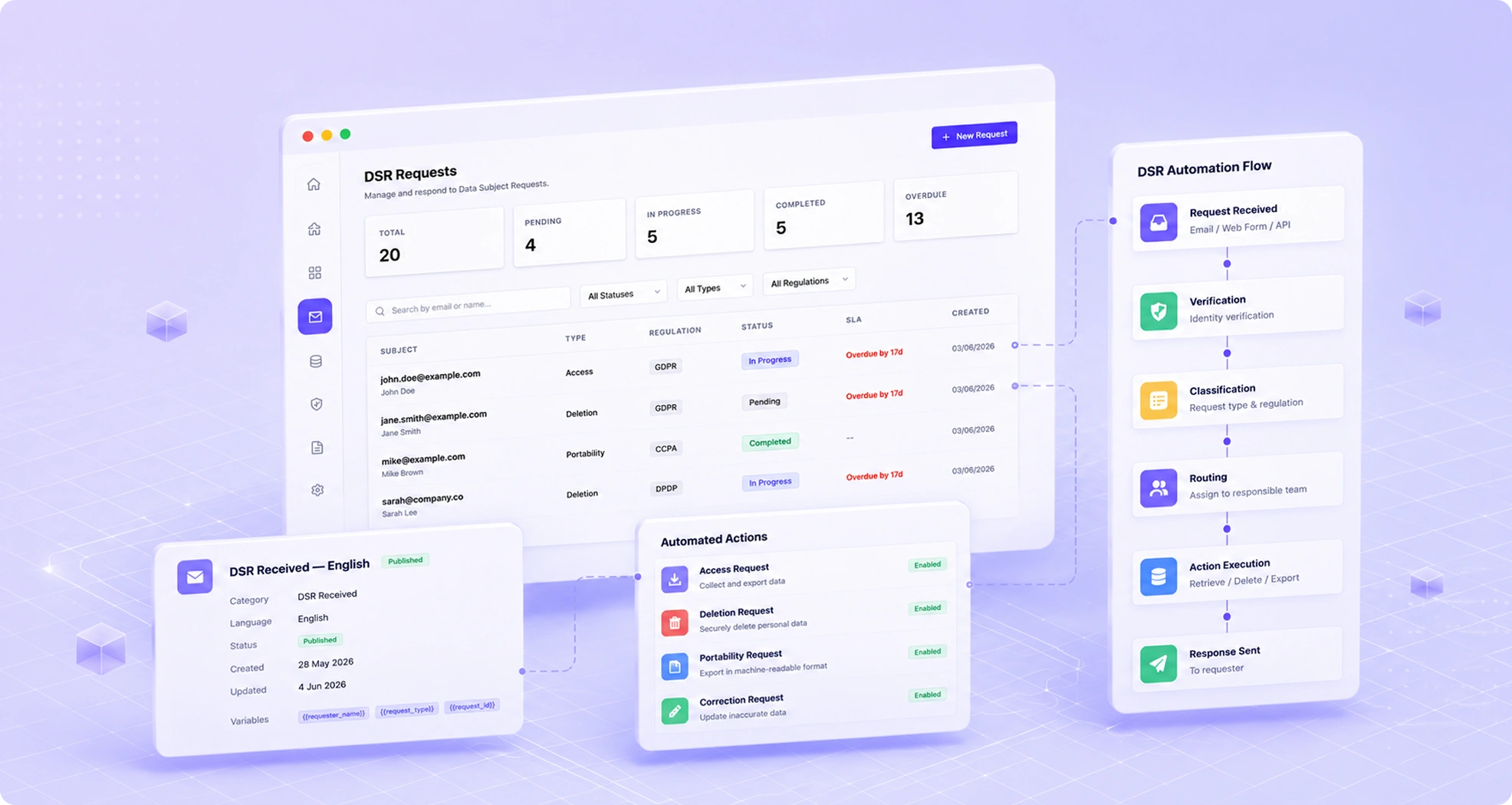
- DSR automation built for national request volumes, with multilingual notices and responses
- SDF readiness: DPIA support, audit evidence, and algorithmic inventory for network and marketing analytics
Platform capabilities
Subscriber Data Lifecycle Engine
Models the subscriber journey — onboarding and verification, active service, plan changes, porting, deactivation — with stage-appropriate retention. Post-deactivation, mandated records are held under cited bases while the remainder is erased on schedule with completion evidence.
Licence-Condition Retention Matrix
A governed matrix mapping verification records, CDRs, IPDRs, and billing data to their licence conditions, DoT directions, and statutory bases — with periods, clock triggers, and expiry-driven deletion. One evidence base answers both the DoT auditor and the DPDP data auditor.
CDR & Location Data Governance
Highest-tier classification with quarantined storage, purpose-logged access, pipeline-level exclusion from commercial analytics, and pseudonymised trail architecture — confining the most intrusive data categories to their lawful purposes technically, not just by policy.
Channel Ecosystem Data Mapping
Distributors, retail agents, tower companies, interconnect partners, VAS providers, and cloud processors inventoried with data categories, roles, and agreement status — powering accurate Section 11 recipient disclosures and downstream erasure propagation.
High-Volume DSR Automation
Self-service intake in your app, automated verification against subscriber credentials, data-map-driven fulfilment, and generated responses in the subscriber's language. SLA timers, escalation tiers, and grievance tracking keep national volumes inside published timelines.
SDF Audit Evidence Layer
Continuous, timestamped evidence across consent records, rights handling, retention enforcement, and breach response — structured for periodic DPIAs, the independent data audit, and Data Protection Board reporting, with an algorithmic inventory covering network optimisation and marketing models.
Key features
What our customers say
At our scale, every DPDP obligation is an engineering problem. TruePrivacy turned rights requests, retention, and consent into pipelines instead of projects — and when the SDF designation conversation started, we already had the audit evidence in hand.
Suresh Raghunathan
Chief Privacy Officer, Vistara Telecom
Frequently asked questions
TruePrivacy splits the request. Subscriber verification records, CDRs, and other data covered by licence conditions or statutory directions are placed under documented retention holds; marketing profiles, app telemetry, and non-mandated data are erased with evidence. The subscriber receives a specific response naming retained categories, their legal bases, and retention horizons — and held records are scheduled for deletion when their clocks expire.
Location and CDR stores are classified at the highest sensitivity tier: quarantined behind role-based access with purpose logging, excluded from analytics and marketing pipelines except under documented lawful bases, and pseudonymised by architecture where trails must persist — stable internal identifiers in the records, identity resolution through a controlled reference table for authorised purposes only.
They run in parallel: TRAI's preference and consent frameworks govern commercial communications, while DPDP governs the underlying personal data processing. TruePrivacy maintains both as one preference layer — DND status, TRAI consent registrations, and DPDP itemised consents — enforced consistently across campaign platforms so a subscriber's choice is honoured everywhere it legally must be.
The platform is built for volume: authenticated self-service intake through your app and web channels, automated identity verification against subscriber credentials, programmatic fulfilment from your data map, and multilingual response generation. Human review is reserved for edge cases, so per-request cost stays flat as volume grows.
TruePrivacy provides the SDF operating layer: a live processing inventory feeding periodic DPIAs, audit-grade evidence for consent, DSRs, retention, and breaches, an algorithmic system inventory for due-diligence obligations, and reporting structured for your DPO's board accountability and the independent data auditor's review.
Privacy compliance for Telecom
Join forward-thinking teams using TruePrivacy to automate their privacy operations.
Free 14-day trial · No credit card required · Setup in minutes