Platform
AI Governance
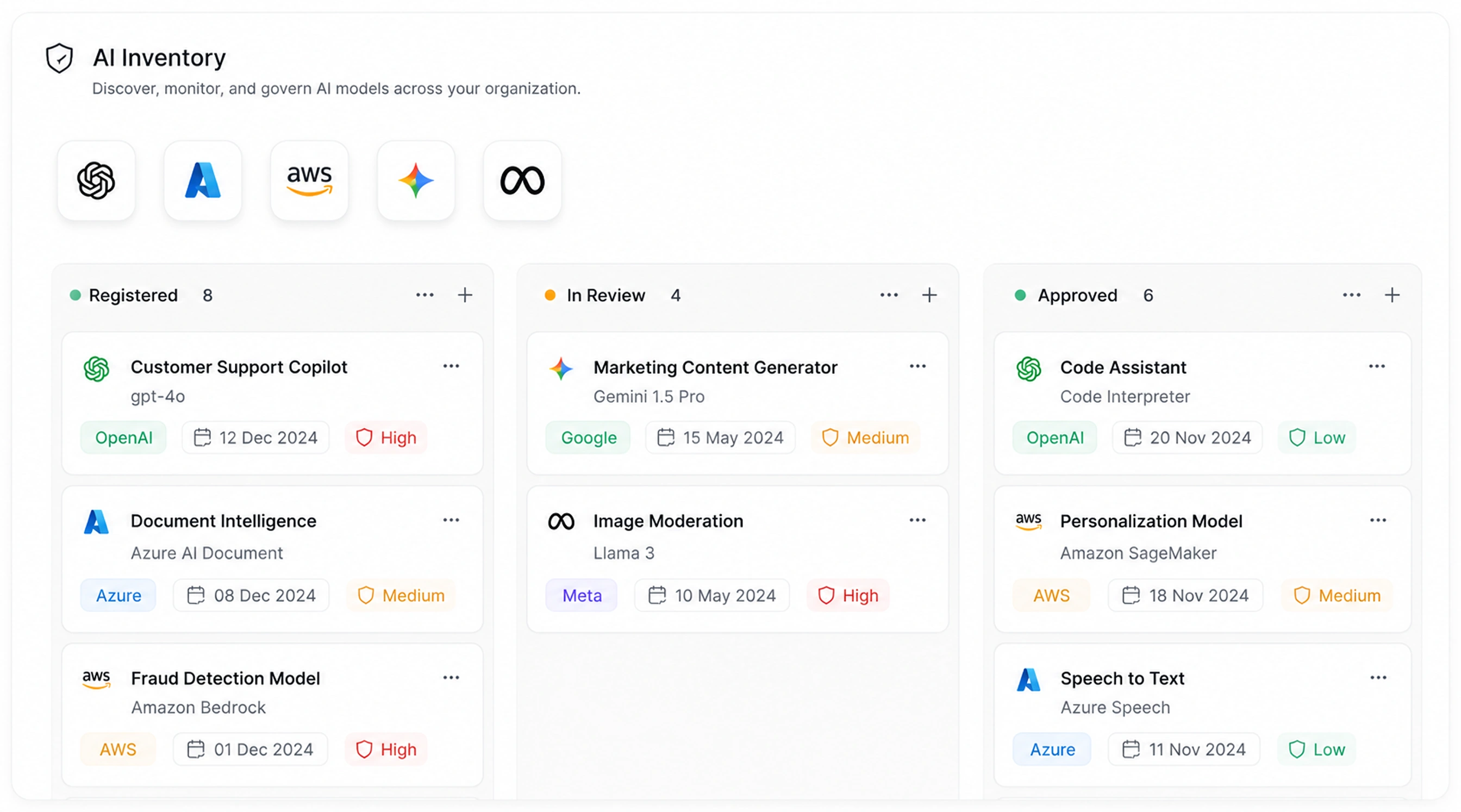
As AI becomes core to your business, TruePrivacy helps you govern it responsibly — mapping AI systems, assessing privacy risks, and documenting compliance for regulators.
Benefits
Why teams choose AI Governance
AI System Inventory
Catalog all AI and ML models in your organization with data inputs, outputs, and risk classifications.
Automated DPIAs
Generate Data Protection Impact Assessments for high-risk AI processing activities automatically.
EU AI Act Readiness
Map your AI systems to EU AI Act risk categories and track compliance requirements.
Bias & Fairness Monitoring
Flag AI systems that may produce discriminatory outputs from personal data processing.
Capabilities
What AI Governance does
AI System Inventory
Maintain a structured registry of every AI and ML model in your organization, including training data sources, data subjects affected, decision outputs, and the business process each model supports.
Automated DPIA Generation
High-risk AI processing activities automatically trigger a DPIA workflow. TruePrivacy pre-populates the assessment with known information about data inputs, processing logic, and likely impacts, reducing assessment time significantly.
EU AI Act Risk Classification
Map each AI system to the EU AI Act's risk categories — prohibited, high-risk, limited risk, minimal risk — and track the conformity obligations that apply. High-risk system obligations are tracked as compliance tasks with deadlines.
Training Data Provenance
Document the origin of training datasets, the consents or legal bases under which personal data was used for training, and any data minimization or anonymization steps applied before training.
Bias & Fairness Monitoring
Flag AI systems that process personal data in ways that could produce discriminatory outcomes across protected characteristics. Link flagged systems to your DPIA workflow for mandatory bias impact assessment.
Model Card Documentation
Generate standardized model cards documenting each AI system's purpose, performance characteristics, known limitations, and privacy risk profile — supporting both internal governance and regulatory transparency obligations.

How It Works
From setup to compliance
A few straightforward steps — no consultants required.
Register Your AI Systems
Add AI and ML models to the registry manually or via API integration with your ML platform. Each entry captures the model's purpose, data inputs, processing logic, and decision outputs.
Assess Risk & Obligations
TruePrivacy evaluates each registered system against EDPB high-risk criteria and EU AI Act categories. Required assessments — DPIAs, conformity obligations — are automatically created as tracked compliance tasks.
Document & Mitigate
Complete assessments collaboratively with stakeholders from legal, data science, and business teams. Mitigation measures are tracked to completion with evidence attachments.
Monitor & Report
Ongoing monitoring surfaces changes in how AI systems are used or the data they process. Regulatory reports for the EU AI Act and GDPR are generated on demand from the registry.
Included
Everything in the box
- AI system registry
- Automated DPIA generation
- EU AI Act risk mapping
- Training data provenance tracking
- Model card documentation
- Regulatory reporting
FAQ
Frequently asked questions
Yes. Third-party AI tools — such as AI customer service platforms, automated credit scoring systems, or HR screening tools — should be registered in the AI system inventory because your organization may be the data controller even when using a vendor's model. TruePrivacy links vendor-provided AI systems to the vendor risk module for integrated assessment.
High-risk systems include those used in employment decisions, credit assessment, educational access, law enforcement, critical infrastructure management, and biometric identification. TruePrivacy maps your registered systems against the Annex III categories of the EU AI Act and flags systems that meet the criteria. The classification is updated automatically when regulatory guidance changes.
Under GDPR, a DPIA is mandatory for any processing that is likely to result in a high risk to individuals, which includes automated decision-making with significant effects, large-scale processing of special category data, and systematic monitoring of publicly accessible areas. TruePrivacy evaluates each registered AI system against these criteria and the EDPB list of processing requiring DPIAs.
TruePrivacy's training data provenance module lets you record the legal basis for each dataset used in training. If consent is the legal basis, you can link the consent records from your consent management module. The system alerts you if training data sources do not have a documented legal basis.
TruePrivacy monitors the data inputs to registered AI systems by analyzing data flows from connected systems. If a model begins receiving data categories that were not present in the original registration, an alert is triggered for review and potential DPIA update.
Ready to automate AI Governance?
Join hundreds of teams using TruePrivacy to manage privacy operations at scale.
Free 14-day trial · No credit card required · Setup in minutes