Solutions
TruePrivacy for
Banking & NBFCs
Privacy governance built for RBI-regulated entities
Banks and NBFCs sit at the intersection of GDPR, the DPDP Act, PMLA retention mandates, and RBI's KYC and cyber security directions. TruePrivacy provides the retention-aware privacy layer that keeps every regulator satisfied.
Common challenges
- PMLA and RBI's KYC Master Direction require identity and transaction records for five years after the relationship ends — colliding with DPDP erasure rights
- Customer data spread across core banking, lending, cards, collections, and dozens of fintech partners
- Credit data reported to bureaus persists outside the bank's direct control
- Parallel breach clocks: DPDP's notify-everything rule, CERT-In's 6 hours, and RBI's incident reporting
- GDPR exposure through NRI customers, foreign branches, and cross-border processing
How TruePrivacy helps
- Retention-aware erasure: PMLA/RBI-mandated records are held with documented legal basis, everything else is deleted verifiably
- Automated discovery and classification of customer PII across core banking, data lakes, and partner systems
- Consent management separating core banking processing from marketing, analytics, and cross-sell
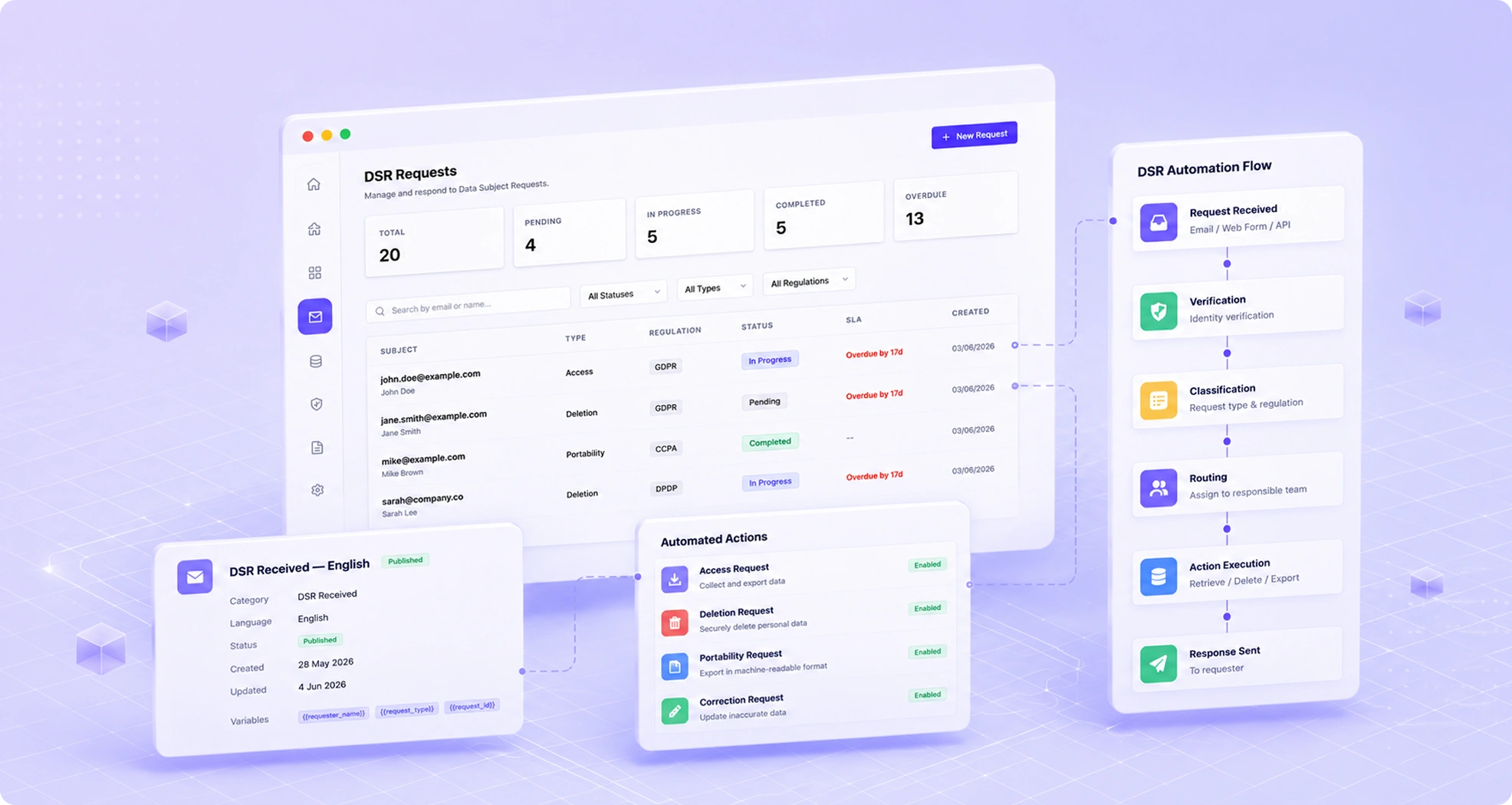
- DSR automation with identity verification, split responses, and bureau-notification steps
- Unified incident response driving RBI, CERT-In, and DPDP notifications from one fact base
Platform capabilities
PMLA/RBI Retention Hold Engine
A governed retention matrix maps every record class to its legal provision — PMLA rules, KYC Master Direction, RBI cyber directions — with period and clock trigger. Holds override deletion automatically, expiry schedules fire deletions when clocks lapse, and every decision carries its citation for both RBI inspectors and DPDP auditors.
Core Banking PII Discovery
Continuous scanning across core banking databases, lending systems, card platforms, data lakes, and collections tooling. Personal data is classified by sensitivity — identity documents, financial data, biometrics — keeping your RoPA and data map current as systems evolve.
Partner Ecosystem Data Mapping
Co-lending partners, DSAs, collection agencies, payment processors, and fintech integrations are inventoried with data categories, legal bases, DPA status, and flow direction. Access-request disclosures and processor erasure propagation draw directly from this map.
Split-Response DSR Automation
Authenticated intake, calibrated identity verification, automated partition against retention holds, and generated responses that cite the specific mandate behind every retained category. SLA timers and escalation keep responses inside published timelines.
Cross-Sell Consent Governance
Granular, itemised consent for marketing, analytics, and cross-sell — captured with immutable records, enforced across campaign tools, and honoured on withdrawal with downstream cessation evidence. Quarantined post-relationship data is technically unreachable by marketing systems.
Unified Incident Command
One workspace for the breach lifecycle: detection timestamping, data-map-driven scoping, role assignments, and parallel notification tracks for CERT-In, RBI, and the Data Protection Board — with customer intimation evidence compiled into the 72-hour report automatically.
Key features
What our customers say
Our data is everywhere — core banking, lending stack, collections vendors, co-lending partners. TruePrivacy gave us one map, one retention policy, and one DSR workflow across all of it. The RBI inspection and our DPDP readiness review now draw on the same evidence.
Kavita Deshpande
Chief Data Officer, Sundaram Capital NBFC
Frequently asked questions
Through retention holds mapped to specific provisions. When a former customer requests erasure, KYC and transaction records under PMLA/RBI mandates are held — with the provision, period, and clock-start documented — while marketing profiles, telemetry, and non-mandated data are erased. The customer receives a split response, and held records are auto-scheduled for deletion when the statutory period expires.
Yes. Connectors and scanners classify personal data across databases, warehouses, object storage, and SaaS tools — identifying identity documents, account data, transaction records, and contact details. Findings feed the data map that powers DSRs, retention enforcement, and breach scoping.
Bureau relationships are modelled as data recipients in your inventory, so access responses disclose them as the DPDP Act requires. For correction requests affecting reported data, the workflow includes a bureau-notification step so corrections propagate under the Credit Information Companies framework rather than being lost in your systems alone.
Core banking processing rests on the banking relationship; marketing, analytics enrichment, and cross-sell require separate, granular consent under DPDP. TruePrivacy captures itemised consents with full records, enforces them across connected marketing platforms, and executes withdrawal downstream — without touching the processing the banking relationship requires.
Yes. A single incident record maintains the timeline, affected-data scope, and remediation evidence. From it, TruePrivacy generates the CERT-In 6-hour report, RBI incident notification, DPDP intimations to affected customers and the Data Protection Board, and the 72-hour detailed Board report — keeping every filing consistent.
Privacy compliance for Banking & NBFCs
Join forward-thinking teams using TruePrivacy to automate their privacy operations.
Free 14-day trial · No credit card required · Setup in minutes