Platform
DSR Automation
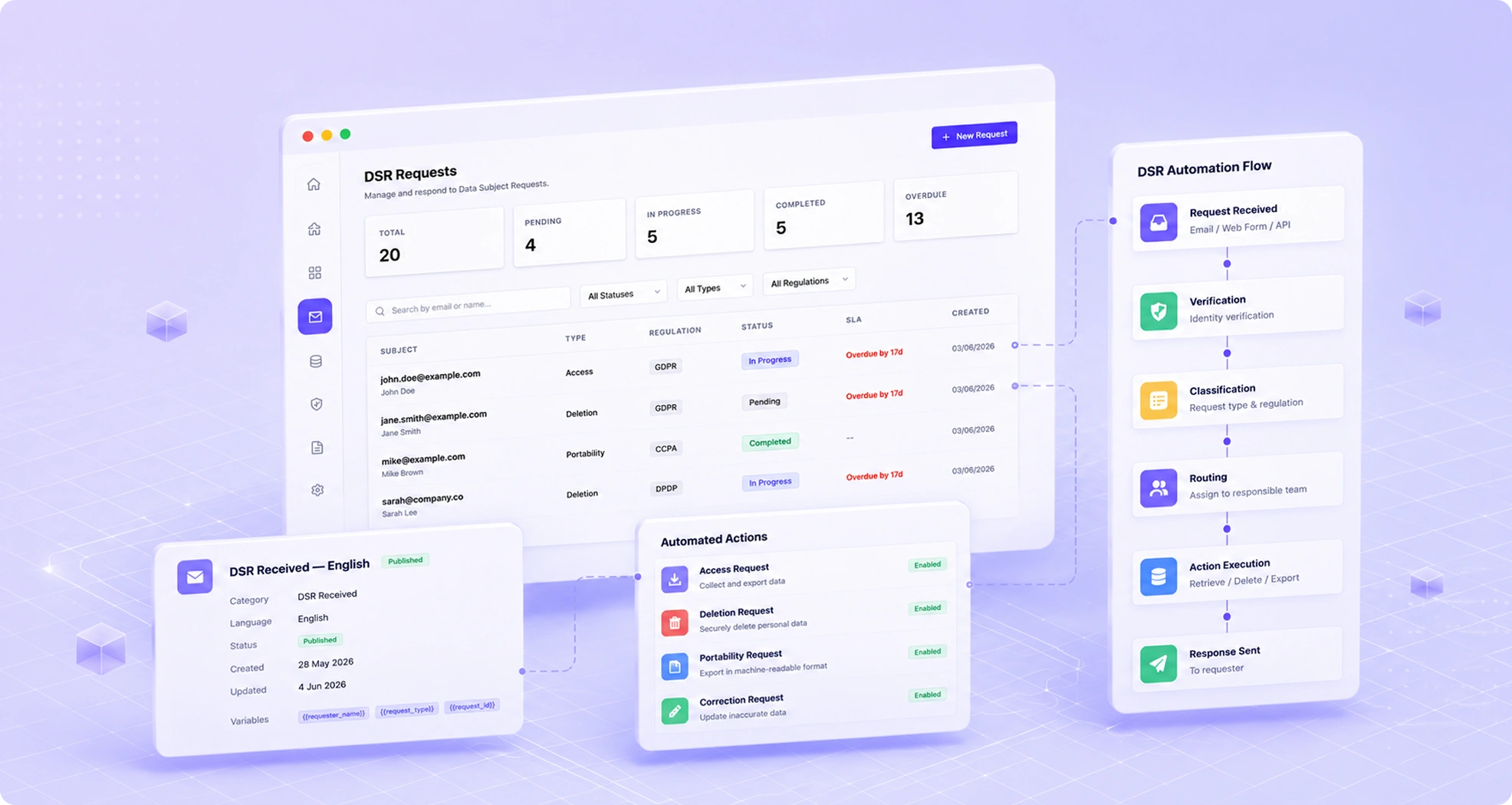
Automate the entire data subject request lifecycle — from intake verification to cross-system execution — so your team can respond in days instead of weeks.
Benefits
Why teams choose DSR Automation
Multi-Channel Intake
Accept DSRs via your Privacy Center portal, email, or API with automatic identity verification.
Cross-System Execution
Execute deletion and access requests across all connected systems simultaneously.
Deadline Tracking
Automatic reminders and escalations ensure you never miss a 30-day regulatory deadline.
Audit Trail
Complete records of every request, action, and response for regulatory proof.
Capabilities
What DSR Automation does
Multi-Channel Request Intake
Accept DSRs through the branded Privacy Center portal, a configurable email inbox, or directly via the REST API. All channels feed into the same unified queue with full context preserved.
Identity Verification Workflows
Configurable verification steps — email OTP, knowledge-based authentication, or ID document check — ensure you only fulfill requests from verified individuals, protecting against fraudulent requests.
Cross-System Execution Engine
Once a request is verified, TruePrivacy propagates it simultaneously to all connected systems. Deletion requests remove data from CRMs, databases, marketing platforms, and data warehouses in parallel.
Deadline & SLA Management
Regulatory deadlines (30 days for GDPR, 45 days for CCPA, 30 days for DPDP) are tracked automatically. Escalating alerts notify team leads when requests approach their deadline.
Stakeholder Collaboration
Route sub-tasks to specific team members or departments — engineering for database deletion, HR for employee records — with individual deadlines and status tracking within each request thread.
Complete Audit Trail
Every action taken on every request — intake, verification, system-level execution, response sent — is logged immutably with timestamps and user attribution for regulatory proof.
How It Works
From setup to compliance
A few straightforward steps — no consultants required.
Receive & Verify the Request
A data subject submits a request via the Privacy Center, email, or API. TruePrivacy captures the request, sends a verification challenge appropriate to the request sensitivity, and logs the intake time for deadline tracking.
Assess Scope
TruePrivacy queries your live data map to identify all systems holding data for the verified individual. The scope summary is presented to the handling team before execution begins.
Execute Across Systems
For deletion requests, TruePrivacy sends deletion commands to all in-scope connected systems simultaneously. For access requests, it compiles a data export from each system. Exceptions or partial failures are flagged for human review.
Respond & Close
A response is sent to the data subject through the configured channel with the outcome. The request record is closed with a full execution log and can be exported as evidence of compliance.
Included
Everything in the box
- Support for right to access, deletion, correction, portability
- Identity verification workflows
- Automated cross-system request propagation
- Configurable deadline rules per regulation
- Stakeholder collaboration tools
- Bulk request handling
FAQ
Frequently asked questions
TruePrivacy handles the full spectrum: right of access (subject access requests), right to erasure (deletion), right to rectification (correction), right to data portability (machine-readable export), right to restriction of processing, and right to object. Request types are configurable per regulation so you only surface request types relevant to your legal obligations.
If a connected system does not support automated deletion — for example, a legacy database without API access — TruePrivacy flags it as a manual task, assigns it to the responsible team member, and tracks completion within the same request thread. The overall request is not closed until all in-scope systems report completion.
TruePrivacy uses proportional verification: low-risk requests (like marketing opt-outs) require only email confirmation, while high-risk requests (full data deletion) can require additional steps like SMS OTP or document verification. The verification level is configurable per request type so legitimate users are not burdened unnecessarily.
Yes. Deadline rules are configured per regulation. GDPR requests are tracked against a 30-day clock, CCPA against 45 days, and DPDP against 30 days. If a request could fall under multiple regulations, the most restrictive deadline applies and all are tracked simultaneously.
Yes. You can create separate request queues for different data subject categories — customers, employees, contractors, website visitors — with tailored intake forms, verification methods, and routing rules appropriate to each group.
TruePrivacy's bulk request handling allows you to process multiple requests of the same type simultaneously. Common in class-action or coordinated erasure campaigns, bulk mode lets you verify a batch, review scope, and execute across systems for all requests in a single operation.
Ready to automate DSR Automation?
Join hundreds of teams using TruePrivacy to manage privacy operations at scale.
Free 14-day trial · No credit card required · Setup in minutes