CCPA Compliance
Automate California privacy compliance for your business
Meet CCPA and CPRA obligations including the right to know, right to delete, right to opt-out, and sensitive personal information controls. TruePrivacy provides purpose-built tools for California privacy compliance at scale.
45 days
Request fulfillment SLA
Auto
GPC signal recognition
100%
SPI categories controlled
Annual
CPRA audit support
How It Works
- 1
Map Personal Information and SPI
TruePrivacy scans your data systems to map all personal information collected about California consumers, with specific identification of sensitive personal information (SPI) categories that carry enhanced obligations under CPRA.
- 2
Deploy Opt-Out Mechanisms
Implement Do Not Sell/Share opt-out links and Global Privacy Control (GPC) signal recognition. TruePrivacy propagates opt-out signals to all connected marketing and advertising systems automatically.
- 3
Automate Consumer Rights Requests
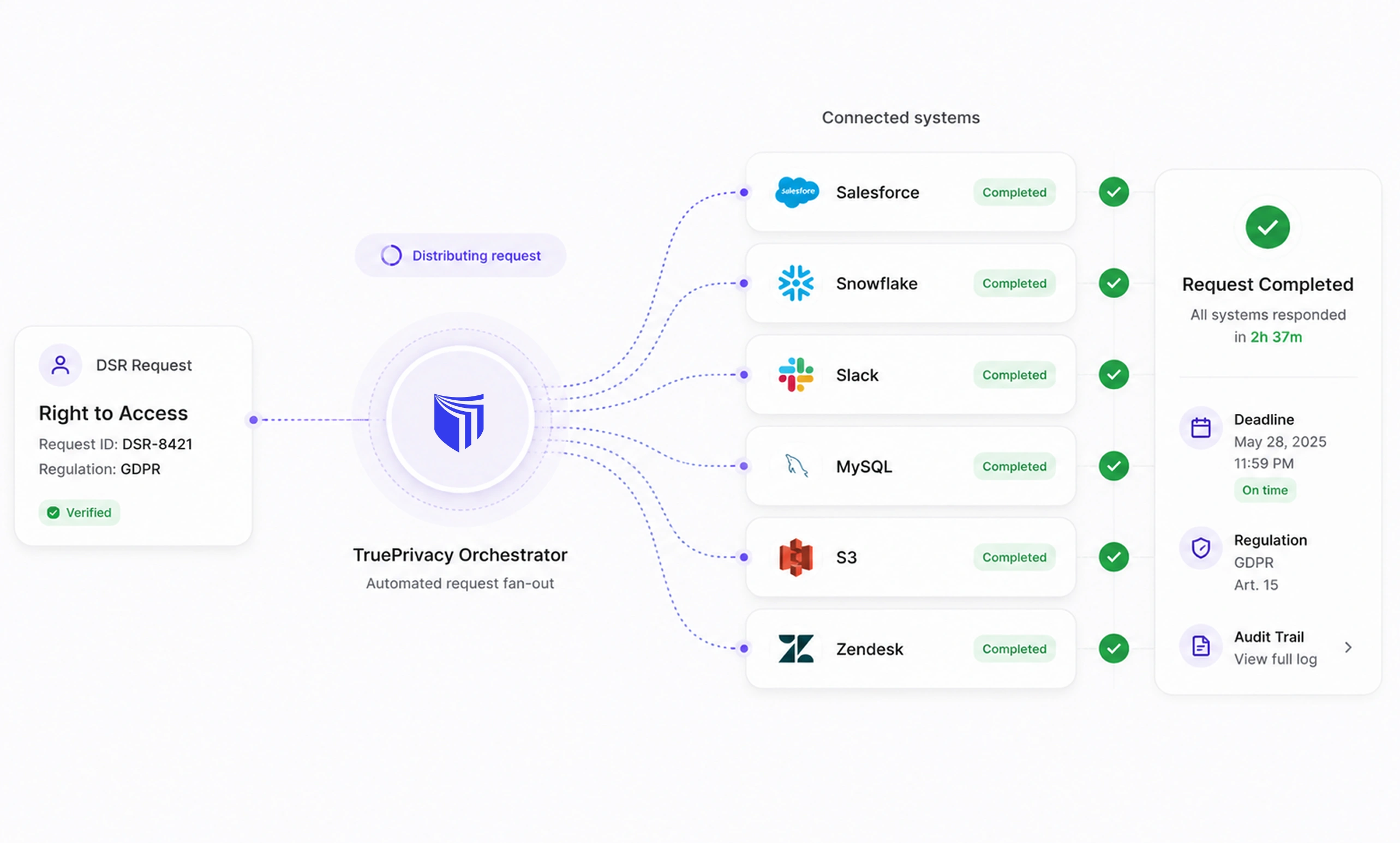
A compliant consumer rights portal handles requests to know, delete, correct, and limit SPI use. Requests are verified and fulfilled within CCPA's 45-day timeline with automated cross-system orchestration.
- 4
Maintain Contracts and Audit Evidence
Manage service provider and contractor agreements, conduct annual CPRA audits, and generate the compliance evidence needed for California Privacy Protection Agency (CPPA) inquiries.
Benefits
GPC Signal Compliance
Global Privacy Control signals must be honored as valid opt-out requests under CPRA. TruePrivacy detects and honors GPC signals automatically across your web properties.
SPI Controls at Scale
CPRA's sensitive personal information category requires additional controls — use limitation, disclosure restrictions, and opt-out rights. TruePrivacy implements these controls systematically.
45-Day Fulfillment
Consumer rights requests must be fulfilled within 45 days (extendable to 90 days with notice). Automated fulfillment ensures you meet this deadline without manual coordination.
CPPA Audit Readiness
California's CPPA conducts proactive audits of businesses. TruePrivacy's annual CPRA audit support and continuous evidence collection prepare you for regulatory scrutiny.
Key Features
- Do Not Sell/Share opt-out management
- Consumer rights request automation
- Sensitive personal information (SPI) controls
- Privacy policy gap analysis for CCPA requirements
- Contractor and service provider agreement management
- Annual CPRA audit support
Detailed Capabilities
PI and SPI Data Mapping
Comprehensive mapping of personal information and sensitive personal information categories across all systems, with CCPA/CPRA classification for each data element.
Do Not Sell/Share Management
Implement and manage Do Not Sell/Share opt-out mechanisms, including GPC signal recognition, with automatic propagation to ad networks and marketing platforms.
Consumer Rights Portal
A branded consumer rights portal handling all CCPA/CPRA request types — right to know, right to delete, right to correct, right to opt-out, and right to limit SPI use.
Sensitive PI Controls
Enforce use limitations on SPI categories — including precise geolocation, biometrics, health data, and financial data — with access controls and disclosure restrictions.
Service Provider Agreement Tracking
Maintain and track service provider and contractor agreements that include the contractual restrictions required by CCPA/CPRA to qualify for the service provider exemption.
Privacy Policy Analysis
Automated analysis of your privacy policy against CCPA/CPRA disclosure requirements, identifying missing categories, outdated descriptions, and required notices.
Who It Helps
Regulations Covered
Frequently Asked Questions
CCPA applies to for-profit businesses that do business in California and meet at least one of: annual gross revenue over $25 million, buy/sell/receive/share personal information of 100,000+ consumers or households, or derive 50%+ of annual revenue from selling or sharing personal information.
CPRA (California Privacy Rights Act) amended and significantly expanded CCPA, effective January 2023. Key CPRA additions include a new sensitive personal information category, the right to correct, the right to limit SPI use, stricter data minimization requirements, and the creation of the California Privacy Protection Agency as the enforcement authority.
The Global Privacy Control (GPC) is a browser signal that communicates a consumer's Do Not Sell/Share preference automatically. Under CPRA, businesses must recognize and honor GPC signals. TruePrivacy detects GPC signals on your web properties and propagates the opt-out to all connected systems automatically.
Selling means disclosing personal information to a third party for monetary or other valuable consideration. This is interpreted broadly and includes sharing data with ad networks and data brokers in exchange for advertising services — even without a direct cash payment.
The CPPA can impose civil penalties of up to $2,500 per unintentional violation and $7,500 per intentional violation. The CCPA also provides a private right of action for data breaches involving certain categories of personal information, with statutory damages of $100–$750 per consumer per incident.
Ready to automate CCPA Compliance?
See how TruePrivacy handles this use case for organizations like yours.
Free 14-day trial · No credit card required · Setup in minutes