Platform
DPIA & PIA
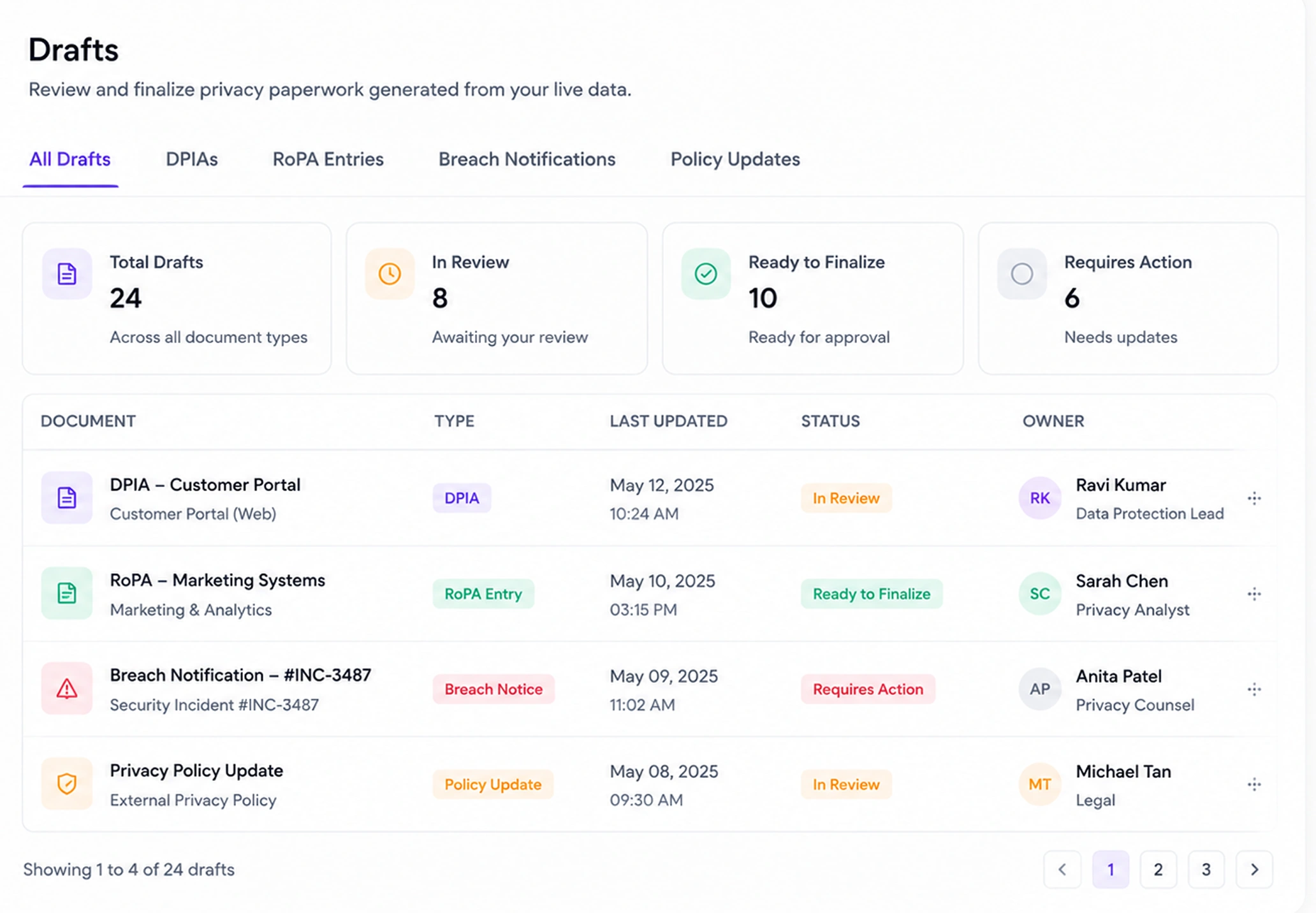
Meet your mandatory DPIA requirements without the spreadsheet chaos. TruePrivacy automates assessment workflows, risk scoring, and documentation for all high-risk processing activities.
Benefits
Why teams choose DPIA & PIA
Automated Triggering
Automatically identify processing activities that require a DPIA based on EDPB criteria.
Collaborative Workflows
Involve DPOs, legal, IT, and business owners in structured assessment workflows.
Risk Register Integration
DPIA findings feed directly into your organizational risk register.
DPA Consultation
Tools to prepare prior consultation submissions to Data Protection Authorities.
Capabilities
What DPIA & PIA does
Automated DPIA Triggering
Processing activities are automatically evaluated against EDPB high-risk criteria and your local DPA's published lists of processing requiring DPIAs. Required assessments are created as tasks before processing begins.
Structured Assessment Framework
Each DPIA follows a structured framework covering necessity and proportionality assessment, risk identification, risk likelihood and severity scoring, and mitigation measure identification — aligned with EDPB DPIA guidelines.
Multi-Stakeholder Collaboration
Assign sections of a DPIA to different stakeholders — IT security for technical risk, legal for legal basis, DPO for overall review. Each contributor works on their section independently and progress is visible to all.
Risk Register Integration
Identified risks and mitigation measures from completed DPIAs feed automatically into your organizational privacy risk register, providing a consolidated view of all outstanding risks across all assessments.
DPO Consultation Workflow
Built-in DPO consultation step with structured sign-off. If the DPO provides an opinion that differs from the project team's assessment, the divergence is documented in the DPIA record as required by GDPR.
Prior Consultation Documentation
When a DPIA concludes that residual risks remain high despite mitigation measures, TruePrivacy generates a prior consultation submission package for your national DPA, pre-formatted to the authority's requirements.
How It Works
From setup to compliance
A few straightforward steps — no consultants required.
Identify Requiring Assessments
When a new processing activity is added to your data map, TruePrivacy evaluates it against DPIA criteria. Activities that require assessment are flagged and a DPIA task is created for the responsible team.
Complete the Assessment
Work through the structured DPIA framework with your team. TruePrivacy pre-fills information from your data map — data categories, systems involved, third parties — so you focus on analysis rather than data gathering.
Review & Approve
The DPO reviews the completed assessment and either approves or requests changes. The approval is recorded with timestamp and any DPO opinion is attached to the record.
Track Mitigations
Mitigation measures identified in the DPIA are tracked as tasks with owners and deadlines. The DPIA risk score updates automatically as mitigations are completed.
Included
Everything in the box
- EDPB criteria-based triggering
- Multi-stakeholder collaboration
- Risk matrix and scoring
- Mitigation measure tracking
- PDF report export
- DPA prior consultation templates
FAQ
Frequently asked questions
Under GDPR, DPIAs are mandatory for processing likely to result in high risk, including systematic and extensive automated decision-making, large-scale processing of special category data, and systematic monitoring of publicly accessible areas. TruePrivacy evaluates your processing activities against these criteria and the specific lists published by your national DPA.
If a processing activity is already running without a completed DPIA, TruePrivacy flags it as a gap and creates a remediation DPIA task. You complete the assessment retrospectively, document any risks that exist in the live processing, and implement any required mitigations. The GDPR requires the DPIA to be completed 'prior to the processing' but retrospective DPIAs are better than none and demonstrate good faith compliance effort.
Yes. TruePrivacy lets you create a DPIA template from a completed assessment and reuse it for similar processing activities. When you create a new assessment from a template, shared sections are pre-filled but reviewers are prompted to confirm each section is still accurate for the new context.
Under GDPR Article 35(2), controllers must seek the advice of the DPO when carrying out DPIAs. This is a mandatory requirement where a DPO has been designated. TruePrivacy's DPO consultation step ensures this requirement is met and documents the DPO's involvement and opinion for every completed assessment.
Prior consultation with your DPA is required when a DPIA indicates that processing would result in a high risk that you cannot mitigate with reasonable measures. TruePrivacy automatically flags when your DPIA reaches this conclusion and generates the required prior consultation documentation package.
Ready to automate DPIA & PIA?
Join hundreds of teams using TruePrivacy to manage privacy operations at scale.
Free 14-day trial · No credit card required · Setup in minutes