Platform
Breach Management
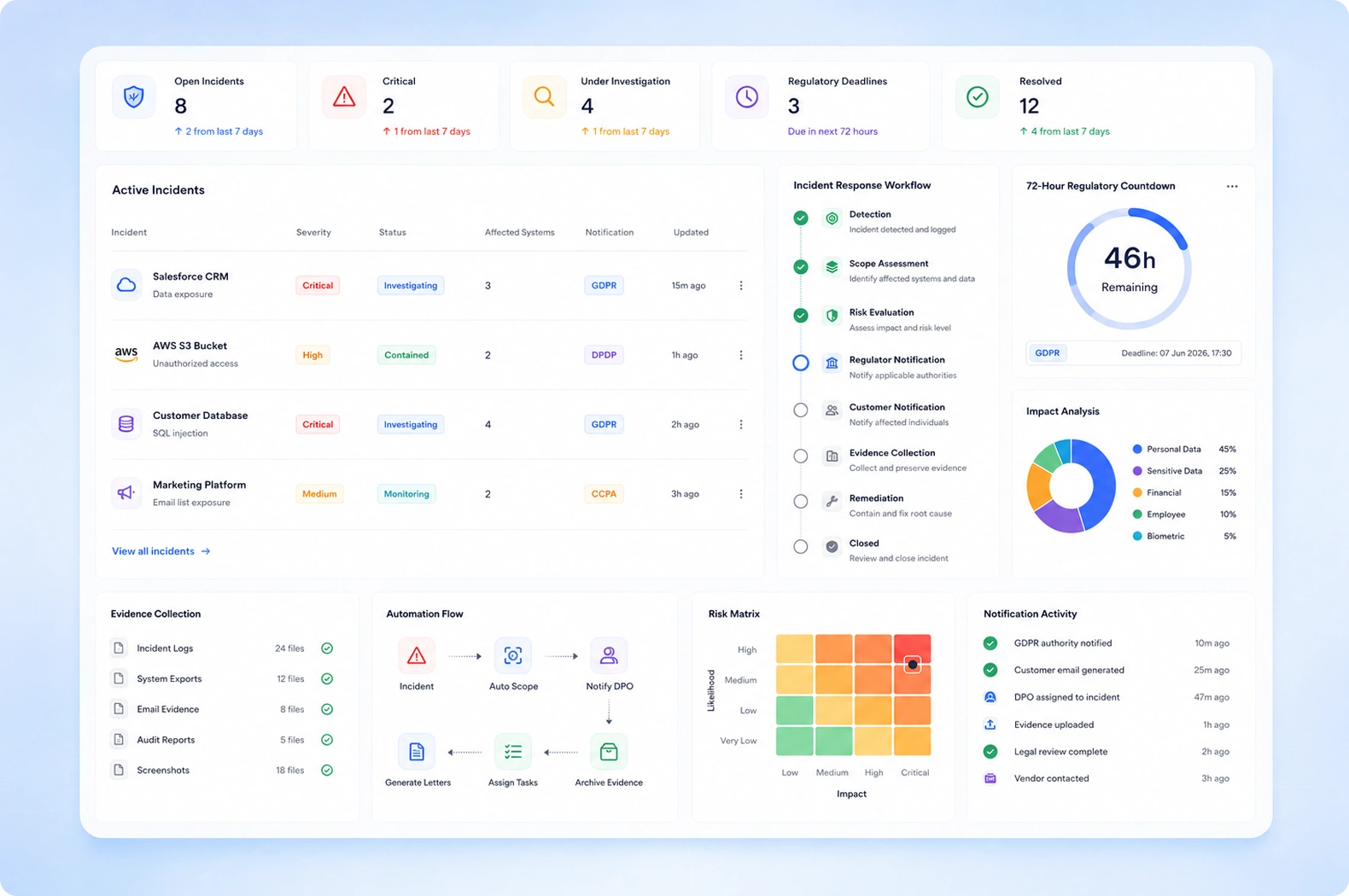
When a breach occurs, every minute counts. TruePrivacy's breach management module guides you through containment, scope assessment, and the complex web of 72-hour notification requirements.
Benefits
Why teams choose Breach Management
Guided Response Playbooks
Step-by-step workflows designed by privacy lawyers guide your team through every breach scenario.
Scope Assessment
Automatically determine affected data subjects and categories using your live data map.
Regulatory Notifications
Generate regulation-compliant notification letters and track submission deadlines.
Post-Breach Learning
Root cause analysis and remediation tracking to prevent future incidents.
Capabilities
What Breach Management does
Guided Response Playbooks
Step-by-step playbooks for common breach scenarios — ransomware, unauthorized access, accidental disclosure — developed with privacy lawyers. Each step includes decision trees, required actions, and sample communication templates.
Automated Scope Assessment
TruePrivacy queries your live data map to automatically identify which data categories and data subjects are affected based on the compromised systems, eliminating the need for manual data discovery during a crisis.
72-Hour Notification Tracking
A dedicated countdown timer and automated escalation chain tracks the GDPR 72-hour DPA notification deadline from the moment a breach is confirmed. Equivalent timers run for DPDP, CCPA, and other applicable regulations simultaneously.
Regulatory Notification Generation
Generate DPA notification letters and data subject notification communications pre-filled with all required information from your breach record. Templates are reviewed by lawyers and structured to meet each authority's published notification requirements.
Evidence & Document Management
A secure document store for all breach-related evidence — incident logs, system exports, communication records, notification confirmations — organized by breach case and retained for the required regulatory period.
Post-Breach Remediation Tracking
Root cause analysis templates and remediation task tracking ensure identified vulnerabilities are addressed systematically after containment. Remediation progress is documented for regulatory follow-up.
How It Works
From setup to compliance
A few straightforward steps — no consultants required.
Log the Incident
When a potential breach is detected — by your security team, a vendor, or an employee — log it in TruePrivacy with the known facts. The system immediately starts regulatory clocks and assigns a severity score.
Assess & Contain
Work through the guided playbook for your breach type. TruePrivacy pulls affected data scope from your data map automatically and presents a structured assessment to determine notification obligations.
Notify Regulators & Data Subjects
Generate pre-populated notification letters for each applicable DPA. For high-risk breaches requiring data subject notification, create and send individual or batch notifications from within the platform.
Close & Learn
Document the full incident timeline, attach evidence, complete the root cause analysis, and track remediation measures. The closed breach record serves as your regulatory evidence file.
Included
Everything in the box
- Incident intake and triage
- Severity scoring
- 72-hour GDPR notification tracking
- DPDP breach notification workflows
- Affected data subject estimation
- Evidence and document management
FAQ
Frequently asked questions
Under GDPR, the clock starts when the controller 'becomes aware' of a breach — which regulators generally interpret as the moment a responsible person in your organization has enough information to confirm a breach has likely occurred, not the moment of first suspicion. TruePrivacy's breach log records the awareness timestamp and starts the countdown from that point.
No. Under GDPR, notification is only required when a breach is likely to result in a risk to the rights and freedoms of individuals. Breaches that are unlikely to result in any risk — for example, encrypted data stolen where the key was not compromised — do not require notification but must still be documented internally. TruePrivacy's risk assessment workflow helps you make and document this determination.
TruePrivacy has notification templates and deadline tracking for all EU/EEA Data Protection Authorities, the UK ICO, India's Data Protection Board, and several US state notification requirements. The list is updated as new regulations and authorities come online.
TruePrivacy integrates with SIEM tools, security platforms, and cloud provider security alerts. When an integrated security system flags an event meeting your configured breach detection criteria, TruePrivacy can automatically create a draft breach record for your team to review and confirm, saving critical time in the early hours of an incident.
TruePrivacy's incident intake workflow includes a triage step specifically for events where it is unclear whether a reportable breach has occurred. You can log a 'suspected incident' which pauses the formal notification clock while your team investigates. If investigation confirms a breach, you convert the record and the clock starts from the original awareness timestamp.
GDPR requires that breach records be maintained indefinitely — there is no specified retention period for breach documentation because they may be needed for regulatory investigations years later. TruePrivacy retains all breach records and their associated evidence in accordance with this requirement. You can export a complete breach record at any time.
Ready to automate Breach Management?
Join hundreds of teams using TruePrivacy to manage privacy operations at scale.
Free 14-day trial · No credit card required · Setup in minutes